Cross-System Operations
When no single system sees the whole operation.
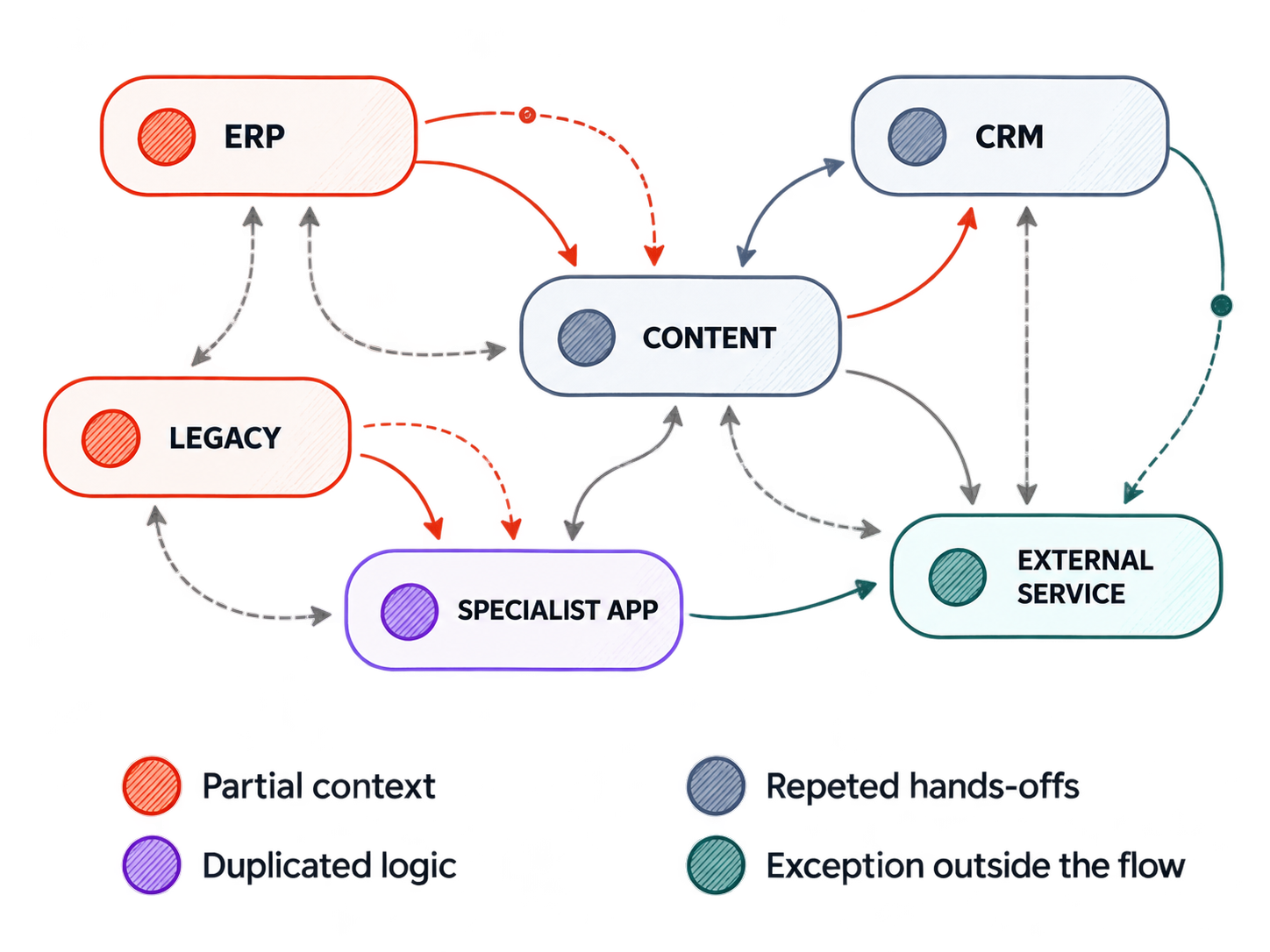
Some operations exist across systems, not inside one of them.
Cross-System Operations are business operations whose context and execution are distributed across multiple enterprise and specialist systems. Each system may do its job perfectly. The challenge is keeping one business reality coherent across them.
THE OPERATION IS SPLIT ACROSS SYSTEMS
Every system knows its part. The business still needs the whole.
ERP, CRM, repositories, specialist applications, legacy platforms and external services are built for different responsibilities. The gaps appear between them.
Systems can become more connected while the operation becomes more fragmented.
Context is scattered
Meaning is rebuilt at every hand-off
Exceptions escape the designed path
Change creates new dependencies
CONNECTIVITY DOES NOT CREATE CONTINUITY
Moving data is not the same as preserving business context.
APIs, events, messaging and integration platforms can connect applications efficiently. But moving data does not preserve the meaning of the operation. The business still needs to know its current situation, what has happened, what evidence supports it, who is responsible and what can happen next. If every workflow or integration has to recreate that context, logic is duplicated and continuity remains fragile.
Connected Systems

One Coherent Operation

The challenge is not connecting more applications. It is preserving one operational reality across all of them.
THE COOPERA SHIFT
Keep the operation whole while systems keep their specialist roles.
Coopera keeps the business object and its context coherent across system boundaries. Existing systems keep their specialist roles, while their actions and results remain connected to the same operation. Change the systems without rebuilding the operation.

Systems manage their part.
Coopera keeps the operation together.
PROVEN IN REAL OPERATIONS
Many systems. One operation. Proven in production.
See how Coopera keeps operations coherent across enterprise applications, specialist platforms, legacy environments and external services.
From purchase order creation to supplier transmission and national e-procurement outcomes, one persistent Purchase Order context across 18 healthcare organizations, thousands of suppliers and multiple execution channels.
From correspondence and administrative resolutions to complex public procedures, one shared operational layer enabling continuous modernization while preserving institutional information and history.
One shared operational layer connecting content, business objects, processes, trust services and enterprise systems across an entire public healthcare authority.